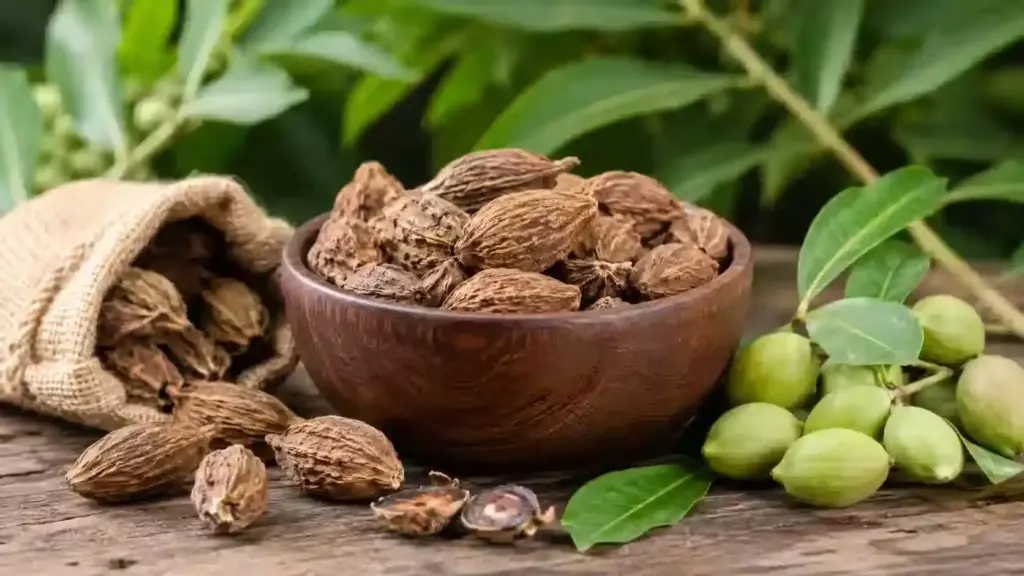
Haritaki (Terminalia chebula) is a small, olive-shaped fruit that has anchored Ayurvedic medicine for more than two thousand years. It’s the herb Ayurvedic practitioners most often reach for when someone needs gentle digestive support, and it’s just as well known for its role in immune health and skin care.
In short: haritaki supports regular digestion, helps the body handle oxidative and microbial stress, and may improve skin healing and texture — largely thanks to its dense concentration of plant tannins, gallic acid, and antioxidant compounds. It’s also one of the three fruits that make up Triphala, Ayurveda’s most widely used herbal blend.
Below, we break down what the research actually shows for each of these three areas, how haritaki is commonly taken, and who should be cautious with it.
Key Takeaways
- Haritaki (Terminalia chebula) is an Ayurvedic fruit rich in tannins, gallic acid, and antioxidant compounds.
- Lab and animal research link it to relief from occasional constipation, antibacterial activity against gut pathogens, and improved gut bacterial diversity.
- A human clinical trial found that daily supplementation reduced facial oil production, redness, and wrinkle severity after 8 weeks.
- It’s typically taken as a powder, capsule, or tea, but it isn’t recommended during pregnancy or alongside certain medications without medical guidance.
What Is Haritaki?
Haritaki is the dried fruit of the Terminalia chebula tree, a deciduous species native to India, Nepal, and parts of Southeast Asia. In Ayurveda, it’s sometimes called the “King of Medicines” because it appears more often in classical texts than almost any other herb.
Most of haritaki’s effects trace back to its concentration of:
- Hydrolyzable tannins — chebulinic acid, chebulagic acid, and corilagin
- Phenolic acids — gallic acid and ellagic acid
- Vitamin C and flavonoids, which contribute to its antioxidant activity
You’ll typically find haritaki sold as a loose powder, in capsules, or as the raw dried fruit. It’s also one of three fruits — alongside amla (Emblica officinalis) and bibhitaki (Terminalia bellirica) — in Triphala, a combination formula used for digestive and general wellness support.
Haritaki Benefits for Digestion & Gut Health
Digestive support is haritaki’s best-documented traditional use, and it’s also the area with the most direct modern research behind it.
Eases Constipation and Occasional Bloating
Haritaki has a mild laxative action, which is why it’s traditionally taken at night with warm water. This effect is largely attributed to its tannin content, which is thought to gently stimulate intestinal contractions and help move waste through the digestive tract.
Fights Harmful Gut Bacteria
A 2024 laboratory study tested fruit extracts of Terminalia chebula (and its close relative Terminalia bellirica) against several gastrointestinal pathogens, including strains of Shigella and Salmonella. The extracts showed measurable antibacterial activity against multiple strains, lending scientific support to haritaki’s traditional use for digestive infections (PubMed, 2024).
Supports Beneficial Gut Bacteria
Perhaps the most compelling modern evidence comes from a randomized, double-blind, placebo-controlled trial in women with an elevated BMI and borderline blood sugar. After 8 weeks of a standardized Terminalia chebula extract, researchers observed increased gut microbial diversity, a rise in short-chain-fatty-acid-producing bacteria, and higher levels of Akkermansia muciniphila — a bacterial species closely tied to gut-barrier and metabolic health (Journal of Functional Foods, 2024).
Haritaki Benefits for Immunity
May Help Modulate Immune Response
In animal research, an aqueous extract of Terminalia chebula fruit produced a dose-dependent increase in both antibody production and delayed-type hypersensitivity — two separate markers researchers use to gauge immune system activity. The study authors described the extract as a promising natural immunostimulant (Journal of Immunotoxicology, via Taylor & Francis).
Antioxidant Protection
Ongoing free-radical damage is one of the underlying stressors that can wear down immune function over time. In laboratory and animal testing, an aqueous extract of Terminalia chebula protected liver cells from oxidative injury, reduced markers of cellular damage, and showed measurable free-radical-scavenging activity in test-tube assays (PubMed).
Haritaki Benefits for Skin Health
Speeds Up Wound Healing
In a controlled animal study, topical application of Terminalia chebula leaf extract accelerated wound contraction and shortened healing time compared to untreated wounds. Treated tissue also showed higher collagen and protein content — key building blocks the body needs to repair skin (Phytotherapy Research, via PubMed).
Supports Skin Cell Renewal
Separate laboratory research found that Terminalia chebula extract encouraged the proliferation of keratinocytes and fibroblasts — the two main cell types responsible for rebuilding skin after injury — while also reducing free-radical activity at the cellular level (PMC, National Institutes of Health).
Human Trial: Less Oil, Redness, and Wrinkling
This is the strongest skin-related evidence available. In a double-blind, placebo-controlled trial published in the Journal of Clinical Medicine, women aged 25–65 took a standardized 250 mg Terminalia chebula extract twice daily for 8 weeks (Chakkalakal et al., J Clin Med, 2023). Compared to the placebo group, the treatment group saw:
- A meaningful drop in forehead oil (sebum) production
- Reduced cheek redness (erythema)
- A measurable decrease in facial wrinkle severity
This is one of the few haritaki benefits backed by human clinical trial data, rather than animal or lab-only research — which is why it’s worth calling out separately.
At a Glance: What the Research Actually Shows
| Benefit Area | Key Compounds | What Research Found | Evidence Type |
|---|---|---|---|
| Digestion | Tannins, chebulinic acid | Inhibited harmful gut bacteria (Shigella, Salmonella, B. cereus) | Laboratory (in vitro) |
| Digestion | Polyphenols | Increased gut bacterial diversity and short-chain fatty acids over 8 weeks | Human clinical trial |
| Immunity | Aqueous fruit extract | Raised antibody levels and immune hypersensitivity response | Animal study |
| Immunity | Tannins, antioxidants | Protected liver cells from oxidative stress | Laboratory / animal |
| Skin | Leaf/fruit extract | Accelerated wound closure and increased collagen | Animal study |
| Skin | Standardized extract (250 mg) | Reduced facial sebum, redness, and wrinkle severity over 8 weeks | Human clinical trial |
Notice that the strongest, most direct evidence — the human trials — centers on gut microbiome changes and skin sebum/wrinkle improvement. The immunity and wound-healing findings are promising but currently come from lab and animal research, which doesn’t always translate directly to humans.
Expert Insight
“It has enjoyed the prime place among medicinal herbs in India since ancient times.”
This is how researchers Ratha and Joshi describe haritaki’s standing in classical Ayurvedic literature, in a peer-reviewed review archived by the U.S. National Institutes of Health (PMC). Modern research is still catching up to that reputation — but as the table above shows, several of haritaki’s traditional uses now have real clinical data behind them.
How People Take Haritaki
There’s no single standardized clinical dose for haritaki in Western medicine. In Ayurvedic practice, it’s typically used in one of these forms:
- Powder (churna): A small amount — often around ½ to 1 teaspoon — mixed into warm water, honey, or ghee, usually taken at night for digestive support.
- Capsules/tablets: Commercially standardized extracts, often 250–500 mg per capsule, taken once or twice daily.
- Decoction/tea: The dried fruit simmered in water and consumed as a tea.
Ayurvedic tradition often pairs morning use (with honey) for digestion and immunity with nighttime use (with warm water) for constipation relief — though these patterns are traditional practices rather than clinically standardized protocols.
Because the right amount depends on the product’s concentration, your health history, and what you’re using it for, talk to a doctor or a qualified Ayurvedic practitioner before starting, especially if you take other medications.
Precautions & Who Should Avoid Haritaki
Haritaki is generally well tolerated in typical amounts, but it isn’t risk-free. Avoid it, or use it only under medical supervision, if you:
- Are pregnant or breastfeeding — its laxative action may not be appropriate during pregnancy.
- Are already dehydrated or prone to diarrhea — the laxative effect can worsen fluid loss.
- Take medication for diabetes or blood sugar — some research suggests haritaki may lower blood glucose, which could add to the effect of these medications (PubMed).
- Have surgery scheduled — stop use beforehand, as with most herbal supplements, unless your doctor says otherwise.
- Take other prescription medications — haritaki hasn’t been studied extensively for drug interactions.
Possible side effects, especially at higher-than-typical amounts, include stomach cramping, loose stools, and dehydration.
Frequently Asked Questions
Is haritaki safe to take every day?
Many people in Ayurvedic practice use haritaki daily in small amounts, but “safe” depends on the dose, the form, and your individual health. Most published research covers only 4- to 8-week periods, so long-term daily use is best done under the guidance of a healthcare provider.
What’s the difference between haritaki and Triphala?
Haritaki is a single herb. Triphala is a three-herb blend that combines haritaki with amla and bibhitaki. Triphala tends to be milder and more balanced for everyday digestive use, while haritaki alone has a stronger laxative effect.
Can haritaki help with weight management?
The research on gut bacteria and metabolic markers suggests possible indirect benefits, but there’s no strong clinical evidence that haritaki causes weight loss on its own. Think of it as potential support for digestion and gut health, not a weight-loss shortcut.
Does haritaki interact with medication?
It may affect blood sugar levels and could interact with diabetes medications or other drugs. Always check with a doctor or pharmacist before combining haritaki with any prescription medication.
Also Read: Did You Know Sugarcane Juice Supports Hydration & Liver Health?
Medical Disclaimer: This article is for general informational purposes only and isn’t a substitute for professional medical advice, diagnosis, or treatment. Haritaki and other Ayurvedic herbs aren’t regulated the same way as pharmaceutical drugs in the United States, and human research remains limited for several of the traditional uses discussed here. Always talk to a licensed healthcare provider before starting haritaki or any new supplement — especially if you’re pregnant, nursing, managing a chronic condition, or taking other medications.