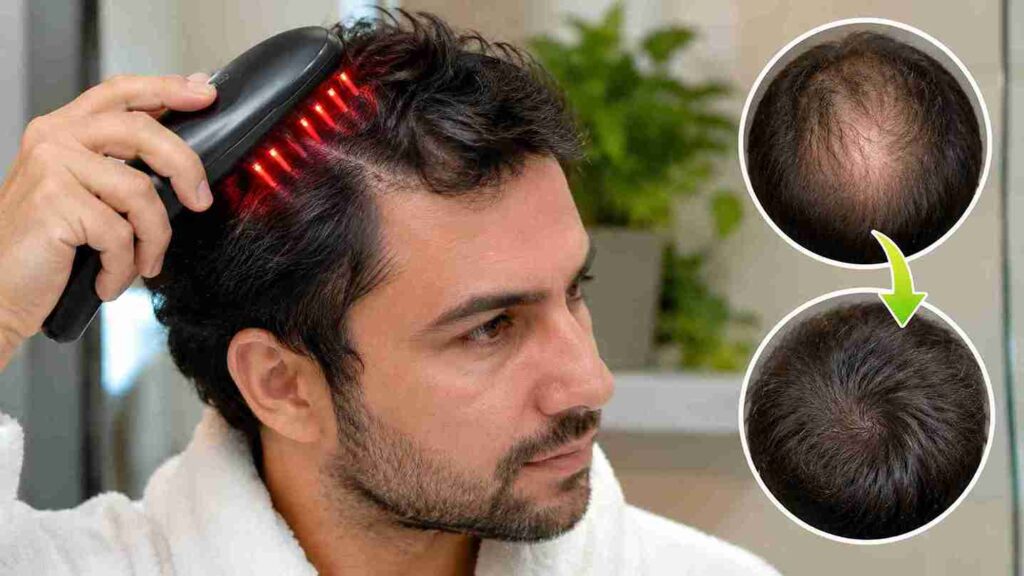
Does an electric comb for hair growth really work? In mice, an experimental electric comb restored nearly all lost hair in four weeks. In people, nobody knows yet, because it hasn’t been tested on humans. The device, called Detangle, was developed by researchers at Beihang University in China and published in Nature Communications on November 3, 2026.
Here’s what you’ll learn:
- How the comb delivers electrical pulses and medicine to hair follicles
- Why electricity alone did far less than the headline number suggests
- Which hair-loss devices have real human evidence today
What Is an Electric Comb for Hair Growth?
An electric comb for hair growth is a comb-shaped device that sends small electrical signals to your scalp. Some versions also deliver medicine. The idea is simple: electrical stimulation may wake up sleepy hair follicles.
The target is pattern hair loss, also called androgenetic alopecia (AGA). It affects about half of men aged 50 or older and more than half of women aged 80 or older.
Not every “electric comb” is the same. Three different things share the name:
- The Detangle comb: a lab prototype, tested only in mice.
- Laser combs: low-level laser devices sold for home use, with human trial data.
- Microcurrent (EMS) scalp tools: consumer gadgets with much thinner evidence.
How the Detangle Electric Comb Works
The Detangle comb looks ordinary, but it works like a delivery system. Its teeth have electrodes of different heights, plus built-in drug-loading modules. The uneven teeth matter. The researchers say the height difference makes the electric field 2.63 times stronger than aligned teeth would, and it reaches about nine times deeper into the follicle region than conventional topical application.
The comb does two jobs at once:
- It stimulates follicles. Electrical pulses encourage growth directly.
- It pushes medicine deeper. A process called electroporation temporarily makes cell membranes more permeable, so therapeutic molecules can travel deeper into the skin.
The team loaded the comb with two experimental genetic treatments. One is a VEGFA plasmid, which promotes blood vessel growth around follicles. The other is SRD5A2 siRNA, which targets a hormone pathway that shrinks follicles.
What the Mouse Study Found
The researchers shaved the mice’s backs and dosed them with testosterone for 28 days to mimic pattern hair loss. Here is how each group did, according to ScienceAlert’s report:
| Treatment (28 days) | Approx. hair regrowth |
|---|---|
| No treatment | ~1% |
| Detangle electrical stimulation only | ~40% |
| Finasteride | ~50% |
| Minoxidil | ~70% |
| Electrostimulation + SRD5A2 siRNA | ~85% |
| Electrostimulation + VEGFA plasmid | ~90% |
| Full Detangle (electricity + both therapies) | ~97.85% |
Source: ScienceAlert’s report on the Nature Communications study.
The authors say the approach delivers regrowth of “nearly 100 percent within a month” in their AGA mouse model.
— Researchers’ paper, Nature Communications, 2026
Read the table carefully. Electrical stimulation alone beat no treatment, but it did less than minoxidil or finasteride. The near-100% result needed the experimental gene therapies too. Those therapies are not approved treatments.
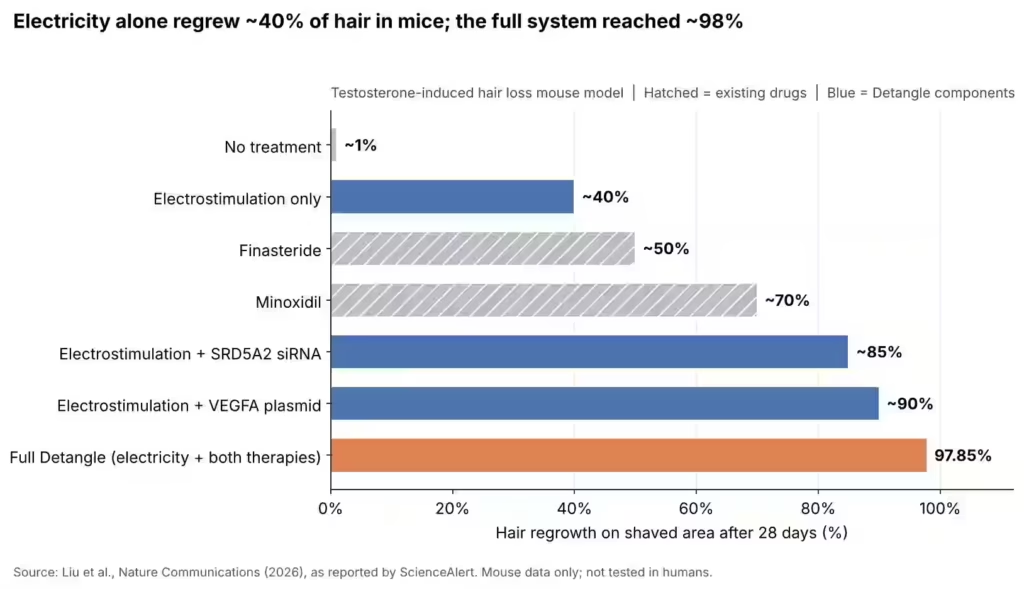
Chart: Hair regrowth in mice after 28 days. Data from Liu et al., Nature Communications (2026), as reported by ScienceAlert. Mouse data only.
Does an Electric Comb Work for Hair Growth in Humans?
Not yet proven for Detangle. Detangle has not been tested in humans, and testosterone-induced hair loss in a lab animal is not the same as human pattern hair loss. Human trials would need to show how well it works, how safe it is, and whether any gains last.
Other devices do have human data, though.
Laser Combs: The Best Human Evidence So Far
Low-level laser therapy (LLLT) combs are the closest thing to a proven hair-growth comb. A meta-analysis of seven double-blind randomized trials found that FDA-cleared home LLLT devices increased hair density compared with sham devices. The benefit showed up with both comb and helmet designs. A separate JAAD meta-analysis concluded that minoxidil, finasteride, and low-level laser therapy all promote hair growth in men with androgenetic alopecia.
There are limits. One critical review noted small sample sizes, a lack of visual evidence, and large differences in study length across LLLT trials. Laser combs also use light, not electricity.
Electrical Stimulation: Early Signals Only
Human evidence for electrical stimulation alone is thin:
- A small human pilot: In a 2025 pilot study, 21 men with AGA wore a low-level electrical stimulation device 30 minutes a day for six months. Total hair density rose 12% at three months and 19.3% at six months, with no adverse events reported. It’s a wearable device, not a comb, and the authors call for larger studies.
- Lab work on microcurrent: A 2021 study tested micro-current stimulation on human hair follicle papilla cells and in a mouse model. The authors say the results suggest a potential treatment strategy.
Benefits of an Electric Comb for Hair Growth
Based on current evidence, here are the realistic upsides:
- Possible stronger follicle activity. The mouse data show electrical stimulation alone beat no treatment.
- Deeper delivery. The Detangle design aims to move medicine into follicles more effectively than creams do.
- A non-surgical option. If future studies confirm the results, the comb could become a less invasive alternative to other hair-loss treatments.
- Possible help for non-responders. Some people don’t respond to minoxidil or see only modest regrowth. That gap is what the Detangle team wants to address.
Risks and Limits You Should Know
- No human data for Detangle. Everything above comes from mice.
- Experimental ingredients. The best results used gene-based treatments that aren’t available to consumers.
- Unknown durability. Researchers still need to learn whether hair coverage holds after treatment stops.
- Safety signals are early. The mouse tests showed no noticeable skin harm. That says little about long-term use in people.
- Marketing outruns science. Retailers sell “5-in-1” scalp devices that combine laser, LED, and microcurrent. Their claims about reactivating follicles don’t match the evidence for the Detangle prototype. Few come with strong human trials.
- Medical conditions. Ask your doctor before using any electrical device if you have a pacemaker or other implanted electronic device, or if you are pregnant.
Also Read: Alopecia and Hair Loss: Types, Causes, and Treatment Options
Electric Comb vs. Minoxidil vs. Finasteride
| Detangle electric comb | Laser comb | Minoxidil / finasteride | |
|---|---|---|---|
| Human evidence | None yet | Multiple randomized trials | Extensive, FDA-approved |
| Available today | No | Yes | Yes |
| Best-known result | ~98% mouse regrowth (with gene therapies) | Higher hair density vs. sham | ~70% / ~50% in the same mouse study |
Note: The mouse percentages in the last row are not human results. Don’t compare them directly with human trial outcomes.
Should You Buy an Electric Comb for Hair Growth Right Now?
Use this checklist before you spend money:
- Can’t buy Detangle. It’s a research prototype.
- Look for human trials. Skip any device that cites only mouse or cell studies.
- Check regulatory status. Look for FDA clearance for hair-growth claims, as laser combs have.
- Be wary of “regrow hair in weeks” promises. Real trials take months.
- See a dermatologist first. Hair loss has several causes, and the right treatment depends on yours.
Frequently Asked Questions
Can an electric comb regrow hair?
Possibly, but it isn’t proven in humans. In mice, electrical stimulation alone produced about 40% regrowth, and the full system with gene therapies reached nearly 98%.
Is the Detangle comb available to buy?
No. It is a lab prototype, and human trials haven’t begun, according to coverage of the study.
Do laser combs work better than electric combs?
Laser combs have more human evidence. Randomized trials show increased hair density versus sham devices. Electrical stimulation has only small pilot studies in people.
Is an electric comb safe?
Detangle showed no noticeable skin harm in mice. Safety in people is unknown. Ask your doctor, especially if you have an implanted device.
How long until an electric comb could reach the market?
Nobody knows. Human safety and effectiveness trials must come first.
The electric comb for hair growth is an exciting idea with strong mouse results and no human proof yet. The full effect depended on experimental gene therapies, not on electricity alone. If you’re losing hair now, treatments with human evidence, such as minoxidil, finasteride, and laser devices, are the safer bet. Talk with a dermatologist about your options.
Disclaimer: The information provided in this article is for educational purposes only and is not intended as a substitute for professional medical advice, diagnosis, or treatment. Always seek the advice of your physician before starting any new health routine.